

What does it mean to truly place people at the center?
In business education, this question often appears in discussions about leadership, innovation, or customer experience. But during a recent practical challenge with Hospital Universitario Fundación Jiménez Díaz, Advantere MIM students had the opportunity to explore it in a very concrete and human context: the patient experience inside a hospital.
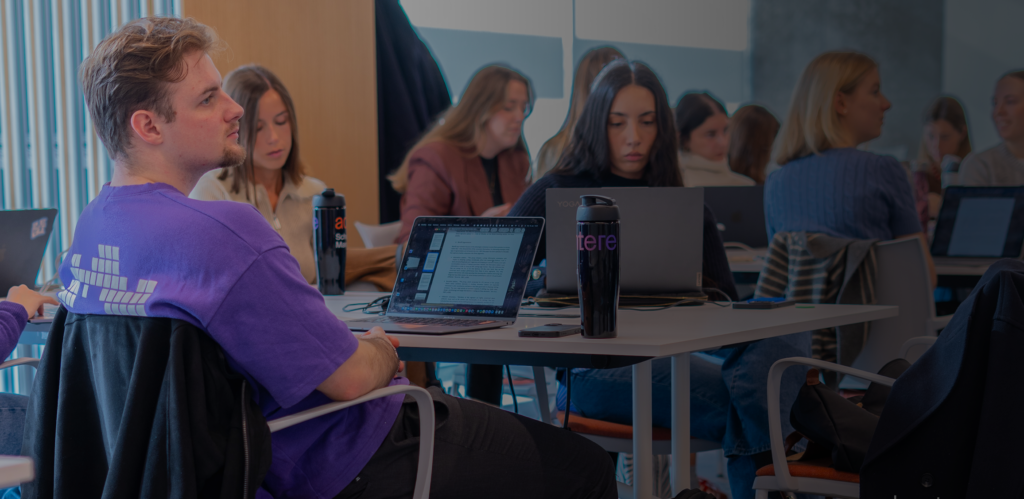
As part of their practical learning journey at Advantere School of Management, students from the Master in Management participated in a design thinking sprint based on a real challenge presented by Hospital Universitario Fundación Jiménez Díaz. The goal was not only to generate ideas for improving the patient experience, but also to understand the emotional and practical difficulties that patients and families may face when navigating a complex healthcare environment.
The project invited students to move beyond the classroom and approach the challenge through observation, empathy, and structured problem-solving. It was an opportunity to apply human-centered design in a real setting, working with a real organization on a challenge with a direct impact on people’s lives.
A real challenge from Hospital Universitario Fundación Jiménez Díaz
For Hospital Universitario Fundación Jiménez Díaz, the challenge was especially relevant because certain processes, pathways, or signage that may feel familiar to those working inside the hospital can be confusing for patients and their relatives.
As Aurora Herráiz Águila, Director of Social Responsibility at Hospital Universitario Fundación Jiménez Díaz, explained, teams inside a hospital can sometimes become used to aspects of the environment that are not as clear for those experiencing it from the outside. This is particularly important for older patients, who may find it more difficult to orient themselves in a large and complex hospital setting.
The challenge presented to the students focused on understanding these difficulties and exploring how the patient journey could be made clearer, calmer, and more accessible.
In a healthcare environment, patient experience is not only shaped by medical care. It is also shaped by how people feel, how easily they can find their way, how much uncertainty they experience, and how supported they feel throughout the process.
Something as simple as locating a consultation room, understanding hospital signage, or identifying the right elevator can have a significant emotional impact. For an older patient, a vulnerable person, or a worried family member, a confusing route can increase stress, insecurity, and anxiety.
That was one of the key ideas behind the challenge: small obstacles can have a big emotional effect.
Why patient experience starts with empathy
The sprint asked students to look at the hospital through the eyes of the people who use it.
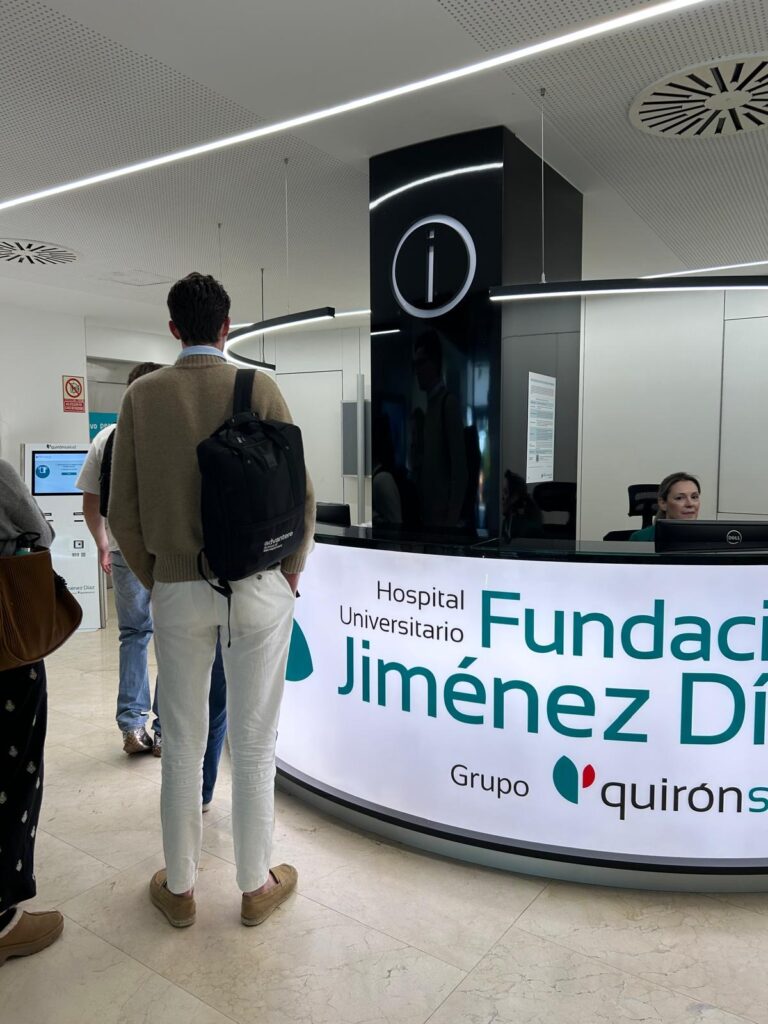
Instead of approaching the problem only from an operational or organizational perspective, students were encouraged to observe the environment as patients and families might experience it. They walked through the hospital, examined signs, corridors, elevator numbers, and different specialty areas, and identified possible points of friction in the journey.
This hands-on observation was essential to the learning process. It allowed students to understand that designing better experiences begins with noticing details that may otherwise be overlooked.
For Aurora Herráiz, incorporating an external and young perspective into a challenge related to patient experience brings freshness, the ability to question established processes, and a strong sensitivity toward the user experience. Students can identify aspects that professionals who work in the hospital every day may stop perceiving precisely because they are so familiar with them.
This external perspective also helps raise awareness among young professionals about the needs of older people and vulnerable users. For students preparing to enter the business world, the experience offered a reminder that future professional challenges will often require not only analytical skills, but also empathy, listening, and the ability to understand people whose needs may be different from their own.
Putting people at the center, in this context, means designing the hospital experience not only from a clinical perspective, but also from the way patients and families feel, move, and make sense of the environment around them.
From observation to possible solutions
Design thinking allowed students to approach the challenge from the human experience, rather than from organizational logic alone.
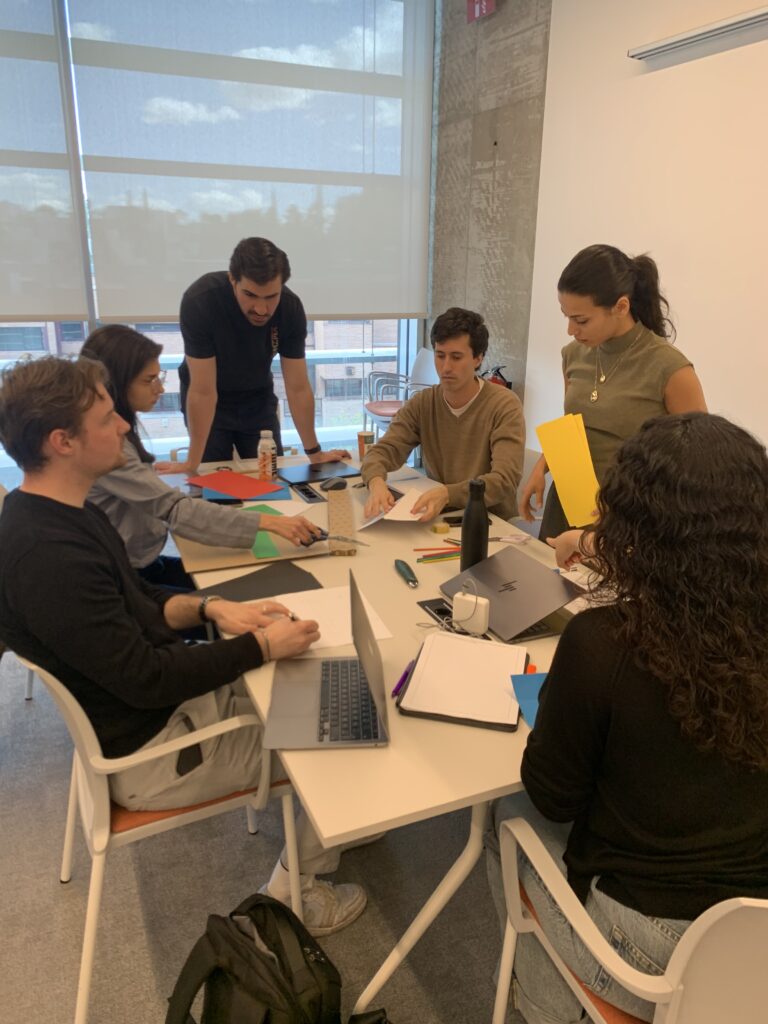
Working in teams, they moved from observation and insight to possible solution pathways. They analyzed pain points, discussed different user needs, and explored practical ideas that could make orientation easier, particularly for older patients.
The process helped students understand that innovation is not always about complex or disruptive solutions. Sometimes, meaningful improvement can come from making an experience simpler, clearer, and more intuitive.
This was especially relevant in the hospital context. Clearer signage, a more understandable route, or a better way of communicating directions can contribute to reducing stress and helping people feel more confident during their visit.
According to Aurora Herráiz, the students approached the sprint with empathy, observation skills, and a genuine desire to understand people’s needs. Their ideas were not only creative, but also practical and realistic.
That balance is central to design thinking: understanding the person, defining the problem carefully, and proposing solutions that are both human and feasible.
What students learned from working on a real healthcare challenge
For the students, the value of the project came from the fact that it was not a theoretical case on paper. It was a real challenge, in a real environment, with real people in mind.
Alba Medina Cruz, one of the MIM students who took part in the experience, reflected on how being a student at Advantere means getting used to working with real-life challenges. In this case, the question was clear: how can we improve the patient experience at Fundación Jiménez Díaz?
To explore it, students went to the hospital and put themselves in the patients’ shoes. By walking through the space, examining signage, corridors, elevator numbers, and specialty areas, they were able to identify potential solutions to make orientation easier, especially for older people.
For Alba, this practical way of working had a strong impact on how students learn and behave. It helped them observe the pain points of a target audience and analyze them with structure. It also encouraged them to immerse themselves in the story behind each challenge and give their best to a project with a real human purpose.
The experience was also meaningful for students with backgrounds connected to healthcare. Carl, another student who participated in the project, highlighted how valuable it was to see what hands-on consulting in the healthcare sector can look like. Coming from a background in medicine, he found it especially interesting to combine practical problem-solving, observation, and empathy in the development of possible solutions for a healthcare setting.
For him, the project was a strong example of project-based learning because it connected classroom methods with a real-world problem. It made the experience more meaningful and showed how design thinking can be applied in a practical context.
Beyond technical knowledge, students practiced skills that are essential for their future careers: working in teams, making decisions, dealing with pressure, structuring complex information, and creating proposals backed by observation and data.
Project-based learning with human impact
This collaboration with Hospital Universitario Fundación Jiménez Díaz reflects one of the core elements of Advantere’s approach to business education: learning by doing.
At Advantere, students do not only study business concepts in the classroom. They apply them to real-life challenges with organizations committed to social impact, interact with complex environments, and develop solutions that connect business thinking with human impact.
For the Master in Management students, the hospital challenge offered a concrete example of what this means in practice. It showed that management education is not only about strategy, performance, or innovation in abstract terms. It is also about learning how to observe, listen, and respond to people’s needs.
The project also reinforced the value of collaboration between academic institutions and organizations in the healthcare sector. These collaborations allow students to face real challenges while helping organizations incorporate new perspectives and ways of thinking.
For Hospital Universitario Fundación Jiménez Díaz, the sprint created an opportunity to receive fresh ideas and external insights. For students, it created an opportunity to contribute, even in a small way, to improving people’s experience in a healthcare environment.
That is one of the most powerful outcomes of project-based learning: students understand that their work can have meaning beyond the classroom.
Learning to place people at the center
By the end of the sprint, the challenge had become more than an exercise in design thinking. It had become a lesson in empathy, responsibility, and human-centered decision-making.
Students were able to see how small details can affect the way people experience a service, especially in moments of vulnerability. They learned that improving a process is not only about efficiency, but also about reducing uncertainty, helping people feel safer, and designing experiences that are easier to navigate.
For Aurora Herráiz, one of the most important takeaways was that students understood the importance of empathy, listening, and human-centered design within healthcare. She also emphasized the value of contributing, even in a small way, to improving people’s lives.
This is also what makes the experience relevant within the broader learning journey of the MIM. Students are not only preparing to become professionals who can analyze markets, manage teams, or design strategies. They are also learning to approach challenges with purpose, sensitivity, and a practical understanding of impact.
At Advantere, learning becomes more powerful when it connects students with real challenges and meaningful impact.
And in this case, placing people at the center began with something simple, but deeply important: learning to see the hospital through the eyes of the patient.